




Think about how you booked a cab five years ago. You opened an app, typed your destination, scrolled through options, and tapped confirm. That was already considered fast.
Now imagine simply saying: “Book me a ride to the airport at 5 AM” — and it is done in three seconds.
That is exactly where multi-service apps are heading in 2026. AI-powered voice booking is no longer a premium feature reserved for big tech companies. It is quickly becoming the standard for any on-demand super app that wants to stay relevant, grow its user base, and outperform competitors.
If you are building or planning to launch a multi-service app — covering rides, food delivery, grocery, home services, or parcels — this article explains exactly why voice booking belongs at the top of your feature list.
What Is AI-Powered Voice Booking?
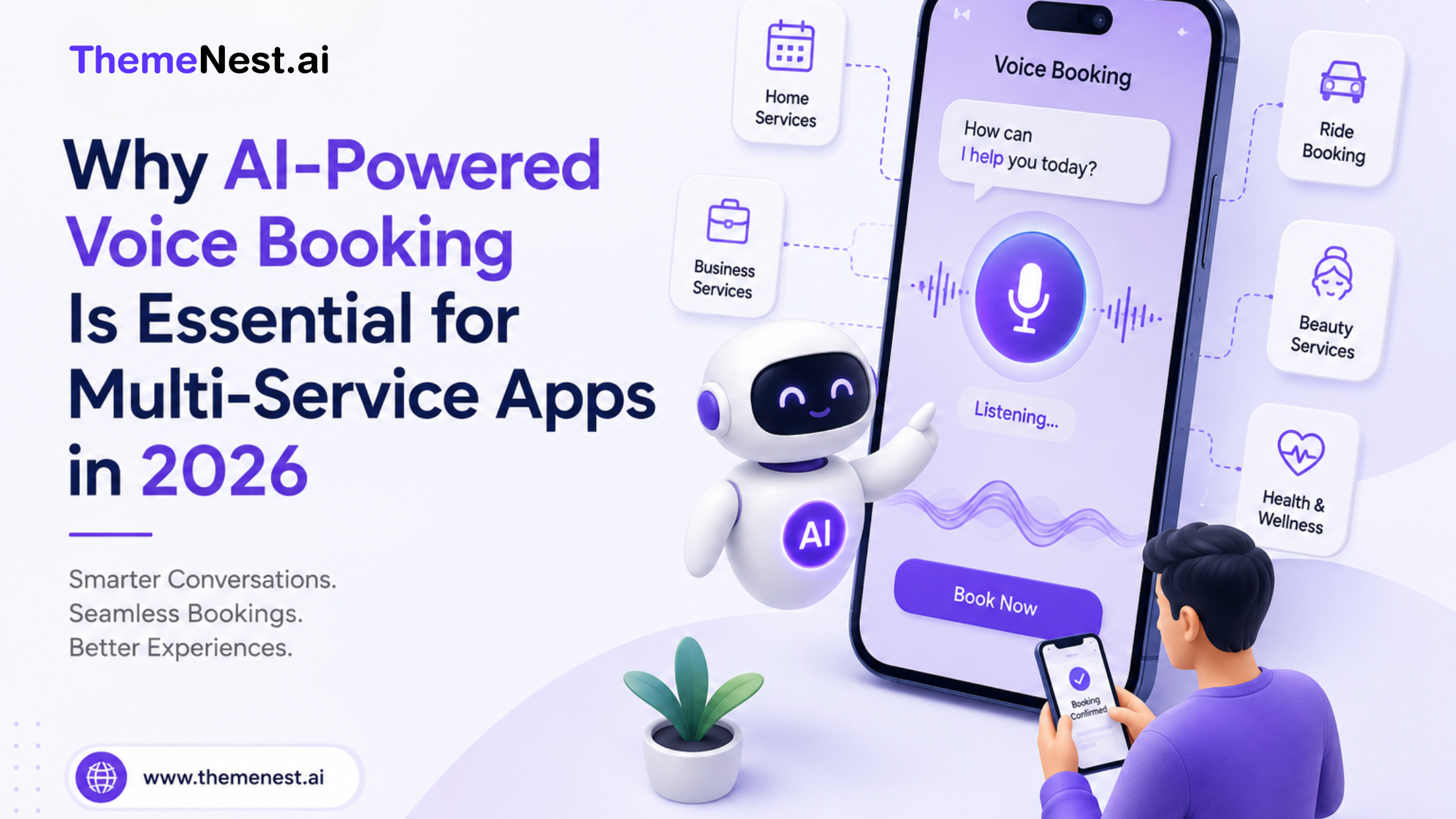
AI-powered voice booking is a feature that allows users to request any service inside a multi-service app using natural spoken language — without typing a single word.
Instead of navigating menus and filling forms, users simply speak their request out loud:
- “Book me a cab to arrive at the airport before 4 AM”
- “Order me a cheeseburger from McDonald’s”
- “Schedule a plumber for tomorrow morning at 10”
- “Send a parcel to my office address”
The app understands the request, identifies the service, processes the details, and confirms the booking — all within seconds.
This is powered by a combination of Automatic Speech Recognition (ASR), Natural Language Processing (NLP), and AI service routing — technologies that have matured dramatically over the last few years and are now accessible to any app development team or white-label platform.
How Voice Booking Works Inside a Multi-Service App
The process feels instant to the user. Behind the scenes, it runs through a precise five-step pipeline that completes in under 3 seconds:
Step 1 — Speech Capture
The user taps a microphone button or uses a wake word. The app activates the microphone and captures raw audio in real time.
Step 2 — ASR Conversion
Automatic Speech Recognition converts the audio into text with high accuracy. This works across multiple languages and regional accents using technologies like Google Cloud Speech-to-Text or custom-trained models.
Step 3 — NLP Intent Parsing
Natural Language Processing analyzes the text to extract the key details — service type, destination, time, preferences (like “cheapest option” or “fastest delivery”), and any special instructions.
Step 4 — Service Routing
The parsed intent is matched to the correct service module inside the app — taxi, food, grocery, home services, or parcel. All relevant parameters are attached to the booking request automatically.
Step 5 — Confirmation and Execution
The user sees a clear summary of their booking on screen. One tap confirms it. The order or ride request goes live instantly.
This five-step process makes voice booking feel effortless — which is exactly why users keep coming back to apps that offer it.
Why Voice Booking Matters More in 2026 Than Ever Before
The numbers behind voice technology make a clear case for why this feature is becoming non-negotiable:
- The global voice recognition market was valued at $12 billion in 2022 and is projected to reach $50 billion by 2029
- More than 8 billion voice assistants are currently in active use worldwide
- Over 149 million Americans are expected to use voice assistants regularly in 2026
- Smartphone penetration has crossed 70% of the global population — but digital literacy has not kept pace
That last point is critical. Across markets like India, Southeast Asia, the Middle East, and Africa — where on-demand apps are growing fastest — millions of smartphone users are not comfortable navigating complex app interfaces or typing in a non-native language.
Voice booking removes that barrier entirely.
5 Reasons Why Multi-Service Apps Need Voice Booking Right Now
1. It Dramatically Reduces Booking Drop-Offs
The number one reason users abandon a booking midway is friction — too many taps, too many fields, too much thinking required.
Voice booking eliminates form-filling completely. A user speaks one sentence and the booking is processed. This directly reduces cart abandonment and increases your completed booking rate — one of the most important metrics for any on-demand platform.
2. It Serves Users That Text-Based Apps Cannot Reach
Multi-service apps operating in emerging markets face a real challenge: not every user is digitally literate. Elderly users, first-time smartphone users, and people who prefer regional languages often struggle with standard app interfaces.
Voice booking speaks their language — literally. When users can interact in Hindi, Bahasa, Tamil, Arabic, or any other language they are comfortable with, your app becomes accessible to a much larger audience.
This is one of the key reasons Gojek grew so successfully across Indonesia — voice and simplified interfaces helped it reach users that competitors could not.
3. It Is Built for the Way People Live Today
People are busy. They are commuting, cooking, managing children, and handling multiple tasks at the same time. Asking them to stop everything and type out a booking is asking too much.
Voice booking fits into real life. Users can book a ride while driving. Order food while working. Schedule a home service while on a call. The hands-free convenience turns occasional users into habitual ones — and habitual users are the foundation of a profitable on-demand platform.
4. It Increases Repeat Usage and Long-Term Retention
Convenience creates habits. Users who discover that voice booking saves them time do not go back to typing. They book more frequently, they book across more service categories, and they stay loyal to the platform that made their life easier.
For a multi-service app operating on a commission model, higher booking frequency directly means higher revenue per user — without any additional acquisition cost.
5. It Positions Your App as a Market Leader
Most multi-service apps in emerging markets have not yet implemented voice booking. That gap is your opportunity.
Launching with AI-powered voice booking signals to users, investors, and partners that your platform is built for the future — not just the present. It differentiates your app immediately in markets where competitors are still relying on basic text interfaces.
Premium positioning is not just about aesthetics. It builds the kind of trust that converts first-time users into long-term customers.
Voice Booking and the Multi-Service App: A Perfect Match
A multi-service super app is, by nature, a complex product. Users need to navigate across ride-hailing, food delivery, grocery, home services, parcels, and more — all within a single interface.
The more services you offer, the higher the cognitive load on the user. Voice booking solves this elegantly. Instead of hunting through menus, users simply state what they need and the app handles everything else.
This is especially powerful for repeat use cases. A user who orders the same breakfast every morning, or books the same commute route five days a week, can complete the entire booking in a single sentence. The app learns their preferences over time and makes proactive suggestions — turning your platform into a genuinely smart assistant.
What This Means If You Are Launching a Multi-Service App
If you are planning to launch a super app or multi-service on-demand platform in 2026, voice booking is one of the features that will separate successful platforms from the ones that struggle to retain users.
The good news is that you do not need to build it from scratch. Modern ready-made app solutions come with voice booking already integrated — along with all the core service modules, admin dashboard, provider apps, and real-time tracking you need.
At ThemeNest, our ready-made products — including RideOn, FoodXpress, FreshMart, and QuickServices — are built with modern, scalable architecture that supports smart features like voice booking out of the box. You get a fully functional multi-service platform without the 6-to-12-month development timeline or the $100,000+ custom build cost.
You focus on your market. We handle the technology.
Frequently Asked Questions
1.What is AI-powered voice booking in a multi-service app?
AI-powered voice booking is a feature that lets users request services — such as a taxi, food order, or home repair — by speaking naturally into their phone. The app uses speech recognition and AI to understand the request, match it to the right service, and confirm the booking automatically.
2.Why is voice booking important for on-demand apps in 2026?
Voice booking reduces booking friction, serves users with low digital literacy, supports multiple languages, and increases repeat usage. In fast-growing markets across Asia, Africa, and the Middle East, it removes real barriers that prevent large portions of the population from using standard text-based apps.
3.How does voice booking work in a multi-service app?
It follows a five-step process: the app captures the user’s speech, converts it to text using ASR technology, analyzes the intent using NLP, routes the request to the correct service module, and presents a confirmation for the user to approve.
4.Does voice booking increase app revenue?
Yes. Voice booking reduces drop-offs during the booking process, increases booking frequency among existing users, and expands the addressable user base — all of which directly contribute to higher revenue on commission-based platforms.
5.Can a multi-service app support voice booking in multiple languages?
Yes. Modern ASR and NLP systems support dozens of languages and regional dialects. For apps targeting markets in India, Southeast Asia, or the Middle East, multilingual voice support is a critical factor in user adoption.
6.Is voice booking hard to add to an existing app?
Retrofitting voice booking into an existing app can be complex and expensive. The most efficient approach is to launch with a ready-made platform that already includes voice booking as a built-in feature.
7.What kind of apps benefit most from voice booking?
Multi-service super apps, ride-hailing platforms, food delivery apps, grocery delivery services, and home services platforms all benefit significantly from voice booking — especially those targeting markets with high smartphone penetration but mixed levels of digital literacy.