





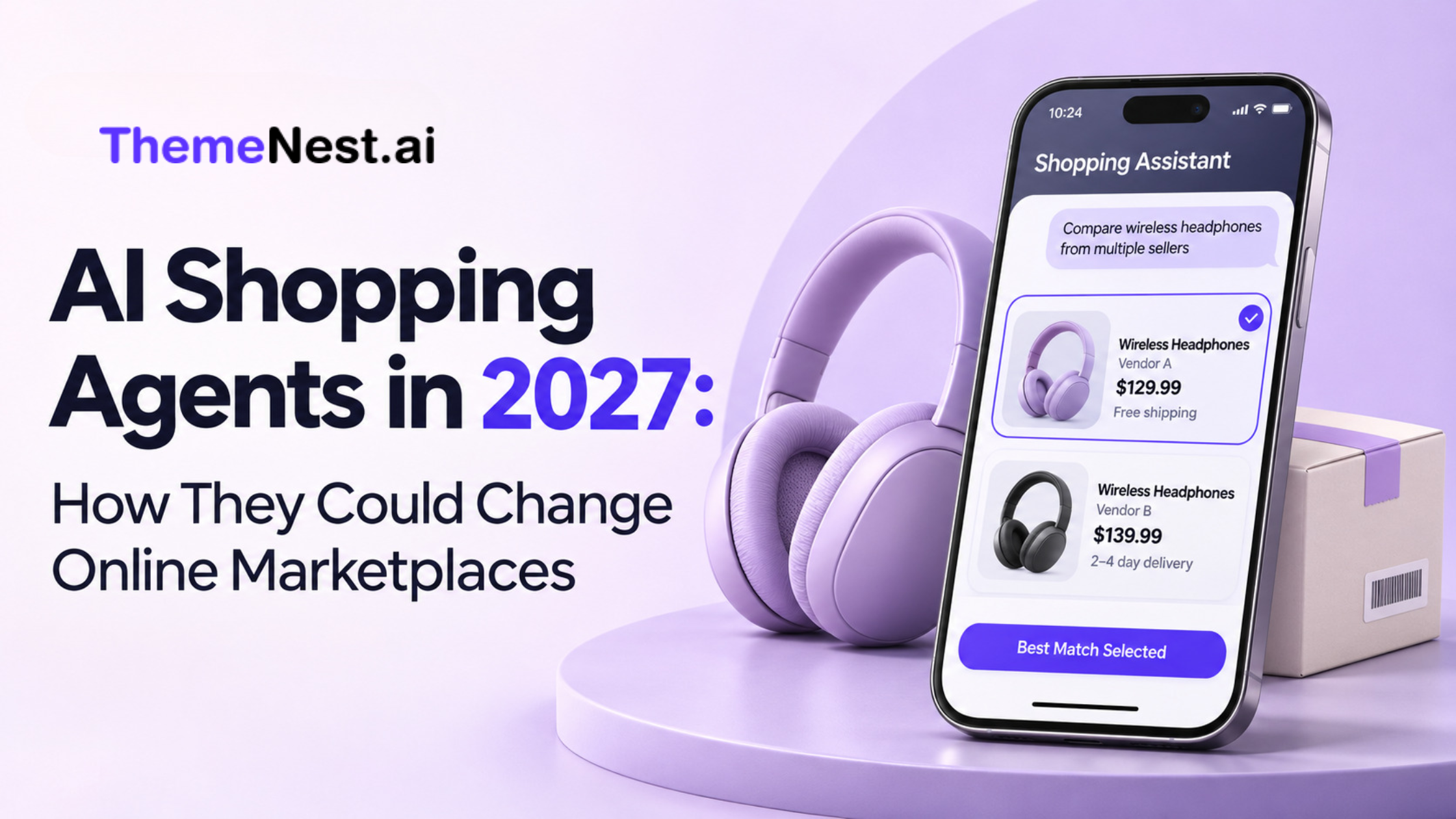
Online shopping has become incredibly convenient, but finding the right product can still take longer than expected. A customer searching for a laptop might open several websites, compare specifications, read reviews, check delivery dates, and search for discounts before making a decision.
Now imagine describing what you need in one sentence and receiving a shortlist of products that actually match your requirements.
That’s the promise of AI shopping agents.
Instead of making customers navigate endless product listings, these intelligent assistants can help them discover products, evaluate alternatives, and move toward a purchase through a conversation.
As we approach 2027, AI shopping agents are becoming an important part of the discussion around the future of eCommerce. For online marketplaces, the opportunity goes beyond adding another chatbot. It could change how customers find sellers, how products are recommended, and how businesses compete for visibility.
What Are AI Shopping Agents?
AI shopping agents are intelligent software assistants that help customers research, compare, select, and sometimes purchase products based on their preferences, requirements, and budget.
Unlike traditional product filters, AI shopping agents can interpret natural language requests and use relevant information to suggest suitable products.
For example, a customer might ask:
“I need a lightweight laptop under $900 for graphic design, with good battery life and delivery before Friday.”
An AI shopping agent could interpret several requirements at once:
- Budget and preferred price range
- Product specifications
- Intended use
- Delivery requirements
- Available alternatives
The assistant could then compare suitable products and explain why particular options match the customer’s needs.
More advanced systems may also help manage shopping carts, check inventory, or initiate checkout when the required integrations and permissions are available.
The important distinction is that an AI shopping agent does more than answer questions. It can help complete parts of the shopping process.
Why AI Shopping Agents Are Becoming Important in 2027
The growing interest in AI-powered shopping isn’t based only on technology announcements. Consumer behavior is already changing.
A McKinsey study published in October 2026, based on research involving approximately 21,000 consumers across 11 markets, found that 53% of surveyed consumers had used AI for at least one shopping-related task during the previous three months.
The research also found that 81% of surveyed AI shoppers agreed that AI helped narrow their choices, while 80% appreciated spending less time scrolling and clicking.
These findings suggest that customers are increasingly interested in tools that make shopping simpler.
However, using AI for research is different from allowing it to make purchases independently. Many shoppers still want to review recommendations and approve their final decisions.
For marketplace businesses, this creates an immediate opportunity: improve product discovery first, then introduce more advanced shopping assistance as customer trust and technology mature.
How Do AI Shopping Agents Work?
AI shopping agents combine conversational interfaces with product information, recommendation systems, and connected commerce services.
Although implementations differ, a typical shopping journey involves five stages.
1. Understanding Customer Intent
The process begins when a shopper describes what they need.
Rather than relying only on exact keywords, an AI assistant attempts to understand the purpose behind the request.
Someone searching for “comfortable shoes for standing all day” may be interested in cushioning, arch support, durability, and fit rather than a particular brand.
This intent-based approach can make product discovery more relevant.
2. Finding Suitable Products
The agent searches available product information to identify potential matches.
Depending on the system, it may access structured catalogs, search indexes, merchant APIs, or other authorized sources.
Accurate product titles, descriptions, categories, prices, and availability information are essential at this stage.
An assistant cannot reliably recommend the right product if the underlying information is incomplete or outdated.
3. Comparing Available Options
Once suitable products are identified, the agent can compare them against the customer’s requirements.
It might highlight differences in price, specifications, delivery options, or seller policies.
For example, it could explain that one smartphone has a better battery capacity while another offers more storage for a similar price.
This saves customers from manually reviewing every product page.
4. Providing Personalized Recommendations
An AI shopping assistant may refine its suggestions based on information shared during the conversation.
If a customer says that battery life matters more than camera quality, the assistant can adjust its recommendations.
Personalization should remain transparent, with customers able to change preferences and understand why particular products are suggested.
5. Supporting Checkout
Some advanced AI shopping systems can connect with carts, checkout services, payment providers, and order-management systems.
However, autonomous checkout is not a universal feature of AI shopping agents. It depends on the platform, integrations, supported payment methods, and customer authorization.
For most retailers, a reliable, customer-approved checkout process remains the practical starting point.
AI Shopping Agents vs Traditional eCommerce Chatbots
AI shopping agents and traditional chatbots can appear similar because both may use conversational interfaces. Their responsibilities, however, can be quite different.
| Feature | Traditional eCommerce Chatbot | AI Shopping Agent |
| Primary purpose | Answer customer questions | Assist with shopping decisions and tasks |
| Product discovery | Basic links or predefined suggestions | Context-aware recommendations |
| Product comparison | Often limited | Can compare multiple product attributes |
| Personalization | Rules or simple customer data | Conversational preferences and context |
| Shopping cart assistance | Depends on integration | Can support cart actions when connected |
| Checkout | Usually redirects customers | May assist or initiate authorized checkout |
| Main value | Customer support | Shopping assistance and task completion |
A chatbot may answer, “What is your return policy?”
An AI shopping agent may help a customer find three suitable products, compare their return policies, and choose an option.
That said, modern AI chatbots can also perform advanced tasks when connected to the appropriate systems. The difference is increasingly about capabilities rather than the name of the technology.
7 Ways AI Shopping Agents Could Change Online Marketplaces
1. Product Search Could Become More Conversational
Traditional marketplace search often begins with short phrases such as “running shoes” or “wireless headphones.”
AI-powered shopping allows customers to describe their needs in greater detail.
A shopper could request affordable running shoes for daily use, suitable for wide feet and available in a particular size.
Instead of displaying hundreds of loosely related results, a marketplace could present a smaller, more relevant selection.
For businesses, this creates a reason to improve product data and search functionality.
2. Personalized Shopping Could Become More Useful
Personalization has existed in eCommerce for years, but many recommendation systems depend heavily on browsing history or previous purchases.
Conversational shopping introduces another source of context: what the customer wants right now.
A customer buying a birthday gift may have completely different requirements from their usual shopping habits.
An AI shopping assistant can respond to those temporary preferences without assuming every recommendation should resemble a previous purchase.
The challenge will be balancing useful personalization with customer privacy and control.
3. Product Comparisons Could Become Faster
Comparing products is one of the most time-consuming parts of online shopping.
Customers often move between browser tabs, trying to remember differences in price, features, warranties, and delivery options.
AI shopping agents could simplify this process by presenting side-by-side comparisons and explaining the trade-offs.
For example, a marketplace selling electronics could help customers compare laptops based on their intended use rather than technical specifications alone.
The benefit is not simply faster shopping. Better comparisons may also help customers make more confident decisions.
4. Multi-Vendor Marketplaces Could Offer Better Product Discovery
Multi-vendor marketplaces face a particular challenge: different sellers often describe similar products in different ways.
One seller may provide detailed specifications, while another uploads a short title and a few images.
AI-assisted discovery could help organize and interpret this information, making relevant products easier to find.
However, marketplace operators will need reliable product data and clear rules for seller visibility.
If recommendations consistently favor certain sellers without a reasonable explanation, customer trust could suffer.
5. Smaller Sellers Could Compete Through Product Relevance
Large marketplaces have significant advantages in advertising, traffic, and brand recognition.
AI-driven discovery may create additional opportunities for smaller sellers whose products closely match specific customer requirements.
For instance, a specialized retailer offering handmade office accessories could potentially appear in a recommendation alongside larger brands.
That opportunity depends on product availability, data quality, recommendation systems, and the rules of the shopping platform.
AI visibility is not guaranteed simply because a product has a detailed description.
6. Shopping Could Extend Beyond Marketplace Websites
Customers are increasingly discovering products through AI assistants, search engines, and conversational interfaces.
This means the shopping journey may begin outside a retailer’s website.
A customer might ask an AI assistant to compare products before deciding which marketplace to visit.
Businesses may therefore need to make product information accessible through supported feeds, APIs, and commerce integrations.
The goal is to help customers discover accurate information wherever their shopping journey begins.
7. Checkout Could Become More Connected
AI-assisted checkout is one of the most discussed developments in agentic commerce.
Google introduced the Universal Commerce Protocol in January 2026 to support interactions among shopping interfaces, merchants, and payment providers.
The protocol is designed to help connect stages of the shopping journey, including product discovery, purchasing, and post-purchase support.
By 2027, businesses may see more opportunities to integrate shopping assistants with their existing commerce infrastructure.
However, secure payments, customer authorization, fraud prevention, and merchant control will remain essential.
What Are the Benefits of AI Shopping Agents for eCommerce Businesses?
The potential value of AI shopping agents is not limited to customer convenience. They may also help businesses improve several important parts of their shopping experience.
More relevant product discovery: Customers can describe their requirements naturally instead of experimenting with multiple search terms.
Reduced decision-making effort: Clear comparisons can make it easier to evaluate products without opening numerous pages.
Better support for complex purchases: Shopping assistants can help explain specifications, compatibility, and differences between similar products.
Improved customer engagement: Conversations allow customers to refine their requirements rather than starting a new search.
Potential conversion improvements: Relevant recommendations and simpler purchase journeys may reduce friction, although results depend on implementation and must be measured.
For marketplace owners, the strongest business case is often not replacing the entire shopping experience. It is improving the moments where customers struggle to find suitable products.
What Challenges Could AI Shopping Agents Create?
Despite their potential, AI shopping agents introduce practical challenges that marketplace operators cannot ignore.
Product Information Accuracy
An AI assistant might recommend an unavailable product, display an outdated price, or misunderstand a specification.
These errors can create frustration and damage trust.
Businesses need dependable product information and suitable integrations to verify details before presenting them to customers.
Customer Trust and Privacy
Customers may be comfortable receiving product suggestions but hesitate to share sensitive information or authorize purchases.
A Gartner survey published in May 2026 found that willingness among surveyed U.S. consumers to let AI make purchase decisions reached only 11% in the lower-stakes categories examined.
This reinforces the importance of customer-controlled shopping experiences.
Recommendation Transparency
Marketplaces must consider how recommendations are selected and ranked.
Sponsored placements, seller incentives, and commercial partnerships should not be disguised as independent recommendations.
Clear disclosures and understandable recommendations can help customers evaluate suggestions.
Integration and Maintenance Costs
Building an effective AI shopping experience involves more than connecting a language model.
Businesses may need product catalog integrations, inventory synchronization, recommendation logic, security controls, and ongoing testing.
These requirements can make advanced implementation expensive, particularly for smaller marketplaces.
How Can Online Marketplaces Prepare for AI Shopping Agents in 2027?
Businesses do not necessarily need to build a fully autonomous shopping system immediately.
A more practical approach is to prepare their existing marketplace infrastructure for AI-assisted discovery.
Improve Product Data Quality
Start by reviewing product titles, descriptions, specifications, categories, images, and availability.
Use consistent attributes across similar products.
For example, if a marketplace sells smartphones, ensure that storage, screen size, battery capacity, and warranty information follow a consistent structure.
Make Product Information Machine-Readable
Structured product information helps search engines and compatible systems interpret product details.
Where appropriate, businesses can use Product structured data, supported merchant feeds, and documented APIs.
These practices support product discoverability, but they do not guarantee inclusion in AI-generated recommendations.
Introduce Conversational Product Search
Instead of immediately automating purchases, businesses can begin with AI-assisted product discovery.
Allow customers to describe what they want, refine their preferences, and compare suitable products.
This provides an opportunity to evaluate customer demand before investing in more complex features.
Connect Reliable Commerce Systems
AI shopping experiences need access to accurate business information.
Depending on the implementation, this may include:
- Product catalogs and inventory
- Current prices and available variants
- Delivery and shipping options
- Shopping cart and checkout services
- Return policies and customer support
Businesses should use authorized integrations, maintain access controls, and avoid exposing unnecessary customer information.
Measure Real Customer Outcomes
Introducing AI does not automatically improve marketplace performance.
Track useful indicators such as product discovery success, recommendation engagement, conversion rates, customer satisfaction, and support requests.
Compare these results with the existing shopping experience before expanding the system.
What Does Agentic Commerce Mean for the Future of Online Marketplaces?
Agentic commerce describes shopping experiences in which AI agents can perform tasks on behalf of customers, within defined permissions and technical capabilities.
It represents a potential shift from customers manually navigating every step toward systems that assist with research, comparison, and selected transactions.
Shopify has already described how its commerce infrastructure supports product discovery through AI channels while maintaining the systems needed for inventory, checkout, and fulfillment.
For online marketplace businesses, this development raises an important question:
Will customers always begin shopping on a marketplace homepage, or will some arrive after an AI assistant has already helped them choose a product?
Both experiences are likely to coexist.
Traditional browsing remains useful for customers who enjoy exploring products. AI-assisted shopping may be particularly valuable when customers have specific requirements and want to make decisions quickly.
The most adaptable marketplaces will be those capable of supporting different customer preferences without sacrificing reliability.
How ThemeNest.ai Fits Into the Future of AI-Ready Marketplaces
Businesses interested in emerging eCommerce technologies still need a dependable marketplace foundation.
Before introducing AI shopping assistants, they must address essential requirements such as product management, vendor operations, customer accounts, orders, and payments.
ThemeNest.ai offers ready-made business software solutions for entrepreneurs and companies looking to launch digital platforms.
For businesses considering a multi-vendor marketplace, a ready-made solution can provide a starting point for building the core shopping experience.
As AI-assisted commerce develops, marketplace owners can evaluate whether their chosen platform supports the APIs, product data access, and customization needed for future integrations.
It is important to verify those capabilities before purchasing or planning an AI implementation. A ready-made marketplace platform should not automatically be assumed to include AI shopping agents.
Conclusion
AI shopping agents could make online marketplaces more conversational, personalized, and convenient in 2027. Rather than searching through countless listings, customers may increasingly rely on intelligent assistants to discover products, compare alternatives, and make informed purchasing decisions.
For marketplace businesses, the priority should be building accurate product catalogs, dependable commerce systems, and shopping experiences customers can trust.
Businesses planning to launch or expand an online marketplace can explore ThemeNest.ai for ready-made software solutions and evaluate how their platform could support future AI-driven commerce requirements.
Frequently Asked Questions About AI Shopping Agents
1.What is an AI shopping agent?
An AI shopping agent is a software assistant that helps customers find, compare, and select products based on their requirements. Advanced agents may also support shopping cart management and authorized checkout through compatible commerce systems.
2.How are AI shopping agents different from chatbots?
Traditional chatbots commonly focus on answering questions and providing customer support. AI shopping agents focus on shopping-related tasks such as product discovery, comparisons, recommendations, and potentially purchase assistance.
3.Can AI shopping agents make purchases automatically?
Some systems can support automated or agent-assisted transactions, but the capability depends on available integrations, payment infrastructure, permissions, and security requirements. Many shopping experiences still require customers to approve purchases.
4.Will AI shopping agents replace online marketplaces?
AI shopping agents are unlikely to eliminate online marketplaces. Marketplaces remain important for product catalogs, seller management, payments, fulfillment, and customer service. AI agents may change how customers interact with those services.
5.How can small eCommerce businesses prepare for AI shopping?
Small businesses can begin by improving product information, maintaining accurate inventory, using structured data, and exploring conversational search tools. Advanced automation can be considered once there is a clear business need.
6.Are AI shopping agents worth investing in for 2027?
They may be worth exploring for businesses with large product catalogs, complicated purchasing decisions, or customers who need help comparing products. The investment should depend on customer demand, implementation costs, and measurable business outcomes.