



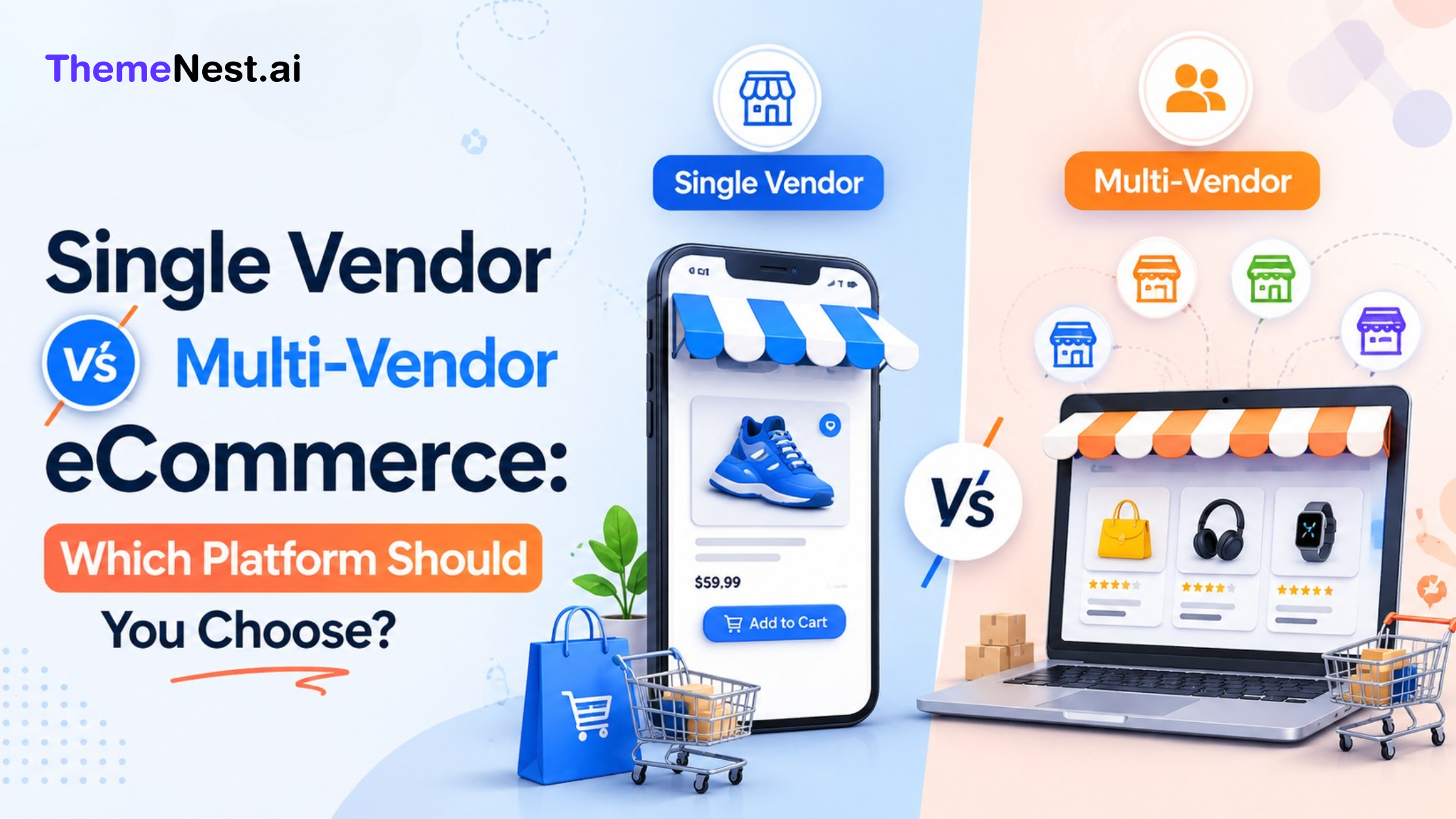
If you are planning to launch an online store in 2026, one of the first and most important decisions you will face is this — should you go with a single vendor eCommerce platform or a multi-vendor eCommerce marketplace?
Both options are powerful. Both can generate serious revenue. But they work very differently, and choosing the wrong one can cost you time, money, and growth opportunities.
In this guide, we break down everything you need to know — simply, clearly, and without the technical jargon — so you can make the right choice for your business.
What Is a Single Vendor eCommerce Platform?
A single vendor eCommerce platform is an online store where only one seller — you — sells products to customers. Think of it like your own branded online shop. You control everything: the products, the pricing, the design, and the customer experience.
Popular examples include a local clothing brand selling directly online, a home bakery taking orders through their own website, or a supplement company running their own store.
Best for: Businesses that sell their own products and want full control over their brand and operations.
What Is a Multi-Vendor eCommerce Marketplace?
A multi-vendor eCommerce marketplace is a platform where multiple sellers list and sell their products — and you, as the platform owner, manage the marketplace and earn a commission on every sale.
Think of it like Amazon, Flipkart, or Etsy — except it is your own platform, under your own brand, with your own rules.
Best for: Entrepreneurs who want to build a marketplace business model and earn without managing their own inventory.
Key Differences: Single Vendor vs Multi-Vendor
| Feature | Single Vendor | Multi-Vendor |
| Who Sells | Only you | Multiple sellers |
| Inventory | You manage it | Sellers manage their own |
| Revenue Model | Direct product sales | Commission + listing fees |
| Setup Complexity | Simple | Moderate |
| Scalability | Limited to your capacity | Scales with more sellers |
| Brand Control | Full control | Shared with sellers |
| Investment Needed | Lower | Moderate to higher |
| Best For | Product-based businesses | Marketplace entrepreneurs |
Single Vendor eCommerce — Pros and Cons
✅ Advantages
- Complete Brand Control Every page, every product, every message — it all represents your brand. You are not competing with other sellers on your own platform. Customers come for you and stay for you.
- Simpler Operations Managing one store with your own products is far simpler than managing hundreds of sellers. You know your stock, your pricing, and your margins at all times.
- Higher Profit Margins Since you are not sharing revenue with a marketplace or paying commission to a platform, you keep more of what you earn.
- Easier Customer Relationships Every customer interaction is directly with your brand. Building loyalty, running email campaigns, and offering personalized experiences is much easier.
- Lower Startup Cost Getting started with a single vendor store is generally more affordable. Ready-made platforms like OpenMart make it even faster and cheaper to launch.
❌ Disadvantages
- Limited Product Range You can only sell what you produce or source yourself. Expanding your catalogue means more investment in inventory and logistics.
- All Marketing Falls on You There is no community of sellers to bring traffic. Every visitor is your responsibility to attract and convert.
- Slower Scaling Growth is tied to your own capacity — how much you can produce, store, and ship.
Multi-Vendor eCommerce — Pros and Cons
✅ Advantages
- Earn Without Selling Your Own Products As a marketplace owner, you earn a commission on every sale made by every seller on your platform — without managing any inventory yourself.
- Faster Catalogue Growth With multiple sellers onboarding, your product catalogue grows rapidly. More products mean more reasons for customers to visit and buy.
- Sellers Bring Their Own Traffic When vendors join your marketplace, they promote it to their own customer base too. Your platform grows through the collective marketing effort of all your sellers.
- Highly Scalable Business Model The more sellers you add, the more your revenue grows — without a proportional increase in your workload or costs.
- Lower Inventory Risk You never own the stock. Sellers handle their own inventory, storage, and shipping — reducing your operational risk significantly.
❌ Disadvantages
- Harder to Build Brand Identity When dozens of sellers are on your platform, building a strong, consistent brand becomes more challenging. The marketplace identity can feel diluted.
- Quality Control Challenges Keeping all sellers accountable for product quality, shipping times, and customer service requires systems, policies, and constant monitoring.
- More Complex to Manage Handling seller onboarding, commission payouts, disputes, product approvals, and ratings requires more infrastructure and attention.
Which One Is Right for You?
Here is a simple way to decide:
Choose Single Vendor If:
- You have your own products to sell
- You want full control of your brand and customer experience
- You are a small business, artisan, or niche brand
- You want a simpler, lower-cost operation
- You are just starting out and want to validate your product
Choose Multi-Vendor If:
- You want to build a marketplace business model
- You do not want to manage inventory yourself
- You have a vision to create the next big online marketplace in your niche or city
- You are comfortable managing seller relationships
- You want a scalable, commission-based revenue stream
Real-World Examples to Help You Decide
Scenario 1 — The Local Clothing Brand Riya runs a handmade clothing label. She wants to sell directly to customers with her own branding and story. → Single Vendor is the right choice.
Scenario 2 — The Marketplace Builder Arjun wants to build a local marketplace for artisans and home-based sellers in his city. He does not plan to sell products himself. → Multi-Vendor is the right choice.
Scenario 3 — The Growing Retailer A mid-size electronics retailer wants to expand online with their own catalogue but may invite other sellers later. → Start Single Vendor, scale to Multi-Vendor.
How Ready-Made Platforms Make It Easy
One of the biggest barriers to launching an eCommerce business used to be the technical complexity and cost. Today, that barrier no longer exists.
Platforms like OpenMart by ThemeNest give you a complete, ready-to-launch multi-vendor eCommerce solution — with a customer-facing website, seller panel, admin dashboard, product management, order tracking, and payment integration — all built in and ready to go.
No developers. No months of building. No massive upfront investment.
Whether you want to launch a single vendor store or a full multi-vendor marketplace, a ready-made platform lets you go live in days — not months — and start earning faster.
Final Verdict
There is no universally “better” option between single vendor and multi-vendor eCommerce. The right choice depends entirely on your business model, your goals, and how you want to operate.
If you want to sell your own products with full brand control → go single vendor.
If you want to build a scalable marketplace and earn through commissions → go multi-vendor.
And if you want to launch either one quickly, affordably, and without technical headaches → a ready-made platform is your fastest path forward.
Ready to Launch Your eCommerce Store?
Whether you are building a single brand store or a full marketplace, OpenMart gives you everything you need to get started today — with free installation, a powerful admin panel, and a mobile-ready design built for growth.
👉 Explore OpenMart on ThemeNest.ai
Frequently Asked Questions (FAQs)
1. What is a single vendor eCommerce platform?
A single vendor eCommerce platform allows one business to sell its own products directly to customers through an online store.
2. What is a multi-vendor marketplace?
A multi-vendor marketplace allows multiple sellers to list and sell products on the same platform, while the marketplace owner earns commissions or fees.
3. Which is better: single vendor or multi-vendor eCommerce?
It depends on your business goals. Single vendor stores offer full brand control, while multi-vendor marketplaces provide greater scalability and multiple revenue streams.
4. Can I start with a single vendor store and upgrade later?
Yes. Many businesses start with a single vendor store and later expand into a multi-vendor marketplace as they grow.
5. Is a multi-vendor marketplace more profitable?
A multi-vendor marketplace can be highly profitable because you earn from multiple sellers without managing inventory yourself.
6. What are examples of multi-vendor marketplaces?
Popular examples include Amazon, Etsy, Flipkart, and eBay, where multiple sellers offer products on one platform.
7. How can I launch an eCommerce platform quickly?
Using a ready-made solution like OpenMart allows you to launch a single vendor store or multi-vendor marketplace faster and more affordably than custom development.