



The on-demand economy is booming. From booking a home cleaning service to calling a plumber or ordering a handyman — people want fast, reliable, and convenient services at the tap of a button.
In fact, the global on-demand services market is expected to cross $600 billion by 2026. Apps like Uber, TaskRabbit, and UrbanClap have already proven the model works. Now, thousands of entrepreneurs are racing to build their own on-demand service platforms. But here is the real question: What separates a successful on-demand app from one that fails within 6 months?
The answer is simple — the right features.
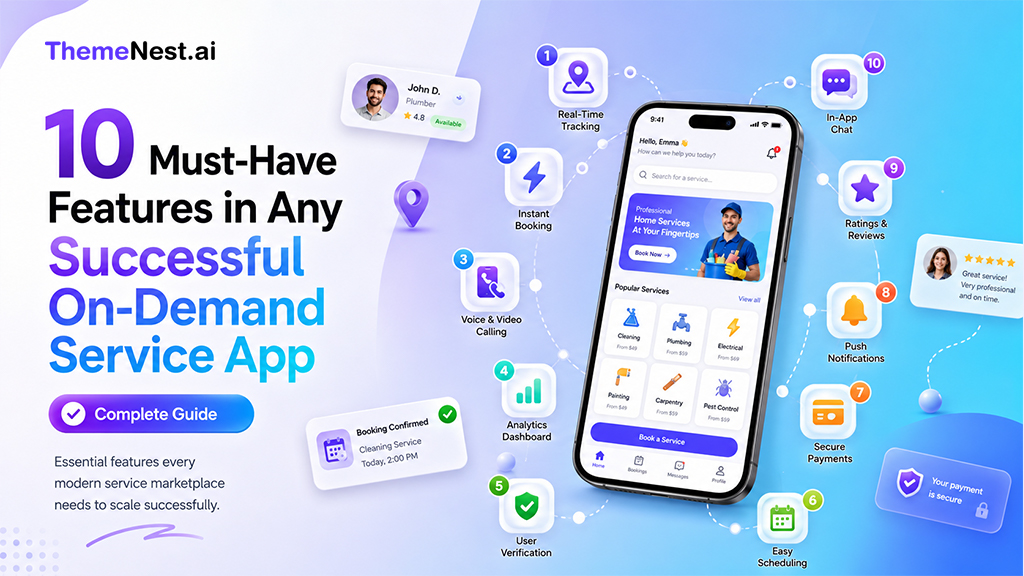
In this blog, we break down the 10 must-have features every on-demand service app needs to succeed in 2026. Whether you are building a home services app, a beauty booking platform, or a repair-on-demand app, these features apply to all.
What Is an On-Demand Service App?
An on-demand service app connects customers who need a service with verified providers who can deliver that service — instantly or at a scheduled time.
Think of it like this: a customer opens the app, selects a service (cleaning, repair, salon, etc.), chooses a provider, makes a payment, and the provider arrives at the location. Everything happens through the app — booking, tracking, payment, and feedback.
These apps typically have three sides:
- Customer App — for people who need services
- Provider App — for service professionals
- Admin Panel — for the business owner to manage everything
Now let us look at the 10 features that make this system work smoothly.
1. Easy Registration and Login
The first impression matters. If a user finds it difficult to sign up, they will leave immediately.
A good on-demand service app must offer:
- One-click sign-up via Google or Facebook
- Phone number OTP verification
- Simple profile setup (name, location, service preferences)
- Option to save multiple addresses
For service providers, the registration process should also include document upload for verification (ID proof, certifications, etc.) to build trust with customers.
Why this matters for SEO and users: A low-friction sign-up directly improves conversion rate and user retention — two metrics that also signal quality to Google.
2. Smart Service Search and Filtering
Once a user is inside the app, they need to find the right service quickly.
Your app must include:
- Category-based browsing (plumbing, cleaning, electrical, etc.)
- Location-based search to show nearby providers
- Filters by price, rating, availability, and experience
- A search bar with auto-suggestions
This feature is especially important for GEO optimization. When your app serves users in specific cities or regions, smart location-based search helps you rank for queries like “home cleaning service near me” or “plumber in Ahmedabad.”
3. Real-Time Service Provider Tracking
This is a non-negotiable feature in 2026. Customers expect to see exactly where their service provider is — just like tracking a food delivery.
Real-time GPS tracking should show:
- Live location of the provider on a map
- Estimated arrival time (ETA)
- Route visualization
- Status updates (accepted, on the way, arrived, in progress, completed)
For the service provider, the app should provide turn-by-turn navigation to the customer’s location.
Real-time tracking builds trust and dramatically reduces “where is my provider?” customer support calls.
4. Secure and Multiple Payment Options
A seamless payment experience is critical. If checkout feels complicated or unsafe, users abandon the booking.
Your on-demand app must support:
- Credit and debit card payments
- UPI, Google Pay, Apple Pay, and wallets
- Cash on service completion (for markets that prefer it)
- Automatic invoicing and payment receipts
- Refund and cancellation payment handling
Security is equally important. All transactions should be processed through encrypted payment gateways. This also helps you rank for keywords like “secure on-demand service payment” and builds customer confidence.
5. In-App Chat and Calling
Before and after booking, customers and service providers need a way to communicate — without sharing personal phone numbers.
In-app communication should include:
- Live chat between customer and provider
- Masked calling (so real phone numbers stay private)
- Pre-booking chat to clarify service details
- Chat with customer support for dispute resolution
This feature improves user experience significantly and reduces booking confusion, cancellations, and complaints.
6. Ratings and Reviews System
Trust is the foundation of any service marketplace. Customers will not book a provider without knowing others had a good experience.
A solid ratings and reviews system must have:
- Star ratings after each completed service
- Written review option
- Provider response to reviews
- Automatic hiding of providers with consistently low ratings
- Verified review badges (only from actual bookings)
From an SEO perspective, user-generated content like reviews helps your platform rank for long-tail keywords naturally. It also feeds Google’s E-E-A-T (Experience, Expertise, Authority, Trust) signals.
7. Scheduling and Booking Management
Not every customer wants an immediate service. Many want to schedule for a convenient time.
Your app should allow:
- Instant booking (as soon as possible)
- Scheduled booking (choose date and time)
- Recurring bookings (weekly cleaning, monthly maintenance, etc.)
- Booking reminders via push notification
- Easy cancellation and rescheduling
For providers, the app should show a calendar view of upcoming bookings and allow them to set their availability.
This feature is a key reason apps like QuickServices succeed — they give customers full control over when the service happens.
8. Push Notifications and Alerts
Push notifications are the lifeblood of engagement in on-demand apps. They keep users coming back and reduce drop-offs.
Use push notifications for:
- Booking confirmations and reminders
- Provider arrival alerts
- Payment confirmation
- Promotional offers and discounts
- New service announcements in the user’s area
Smart, personalized notifications (not spam) significantly improve retention rates and repeat bookings. This directly improves your app’s long-term revenue.
9. Provider Dashboard and Earnings Management
Your service providers are your most valuable asset. If they do not earn well or lack clarity on their performance, they will leave your platform.
A strong provider dashboard must include:
- Daily, weekly, and monthly earnings summary
- Completed vs. cancelled job history
- Ratings and customer feedback overview
- Payout status and withdrawal options
- Demand heatmaps to show where jobs are concentrated
When providers feel informed and empowered, they deliver better service — which directly improves customer reviews and your platform’s reputation.
10. Admin Panel with Full Business Control
Behind every successful on-demand service app is a powerful admin panel that lets the business owner manage everything from one place.
The admin panel should give you:
- User and provider management (approve, suspend, delete accounts)
- Real-time order and booking monitoring
- Revenue and commission tracking
- Promo codes and discount management
- Service category and pricing control
- Analytics dashboard (bookings, revenue, growth trends)
- Customer support ticket management
Without a strong admin panel, scaling your on-demand business becomes chaotic. This is why platforms like QuickServices by ThemeNest.ai come with a fully built, ready-to-use admin panel — so you can focus on growing, not managing chaos.
Bonus Feature: Multi-Language and Multi-Currency Support
If you plan to expand your on-demand service app beyond one city or country, multi-language and multi-currency support is essential.
This helps you:
- Serve users in their native language
- Accept payments in local currencies
- Expand to new markets faster
- Rank in local Google search results (GEO SEO)
How to Launch an On-Demand Service App Fast in 2026
Building all these features from scratch takes 6 to 12 months and can cost anywhere between $30,000 to $100,000+ in development costs.
A smarter and faster approach is to use a ready-made on-demand service platform.
ThemeNest.ai offers QuickServices — a complete, ready-to-launch on-demand services platform that includes every feature listed above. It comes with:
- Customer App
- Provider App
- Admin Panel
- Website
- Full customization to match your brand
You can go from zero to live in as little as 5 to 10 business days — at a fraction of the custom development cost.
Conclusion
The right features do not just make your app look good — they make it work. Real-time tracking, secure payments, smart booking, and a powerful admin panel are what turn a simple idea into a business that scales.
You do not need months of development or a massive budget to get started. With QuickServices by ThemeNest.ai, every feature in this list is already built, tested, and ready to launch — in as little as 5 to 10 days.
Your competition is already moving. It is time you do too.
Frequently Asked Questions
1. What are the must-have features of an on-demand service app?
The most important features include real-time tracking, secure payment options, in-app chat, ratings and reviews, easy booking and scheduling, push notifications, a provider dashboard, and a strong admin panel.
2.How much does it cost to build an on-demand service app?
Custom development can cost $30,000 to $100,000 or more. Using a ready-made solution like QuickServices from ThemeNest.ai can reduce this cost significantly and launch your app in days, not months.
3.What is an on-demand service app?
An on-demand service app connects customers who need a service (like cleaning, plumbing, or repairs) with verified service providers in real time, through a mobile or web platform.
4. How long does it take to launch an on-demand app?
With a ready-made platform, you can go live in 5 to 10 business days. Custom development typically takes 6 to 12 months.
5.Which industries use on-demand service apps?
Home services, beauty and wellness, healthcare, logistics, food delivery, grocery, education, and ride-sharing are the most common industries using on-demand apps in 2026.