



Customers no longer want to search for a different provider every time they need their home cleaned, an air conditioner repaired, a parcel delivered, or a plumber called. They expect nearby services to be easy to discover, simple to book, transparently priced, and available through one trusted platform.
This is where a local multi-service app creates value. It brings customers and verified local professionals together through a single digital marketplace. A Gojek clone script can provide the technology foundation for building this type of platform without developing every booking, payment, tracking, and provider-management feature from the beginning.
The real opportunity is not simply offering many categories. It is organizing services that people regularly use and making each booking reliable. Home cleaning, appliance repair, beauty at home, laundry pickup, pest control, vehicle assistance, and other neighbourhood services can become separate revenue-generating modules within one app.
What Is a Local Multi-Service App?
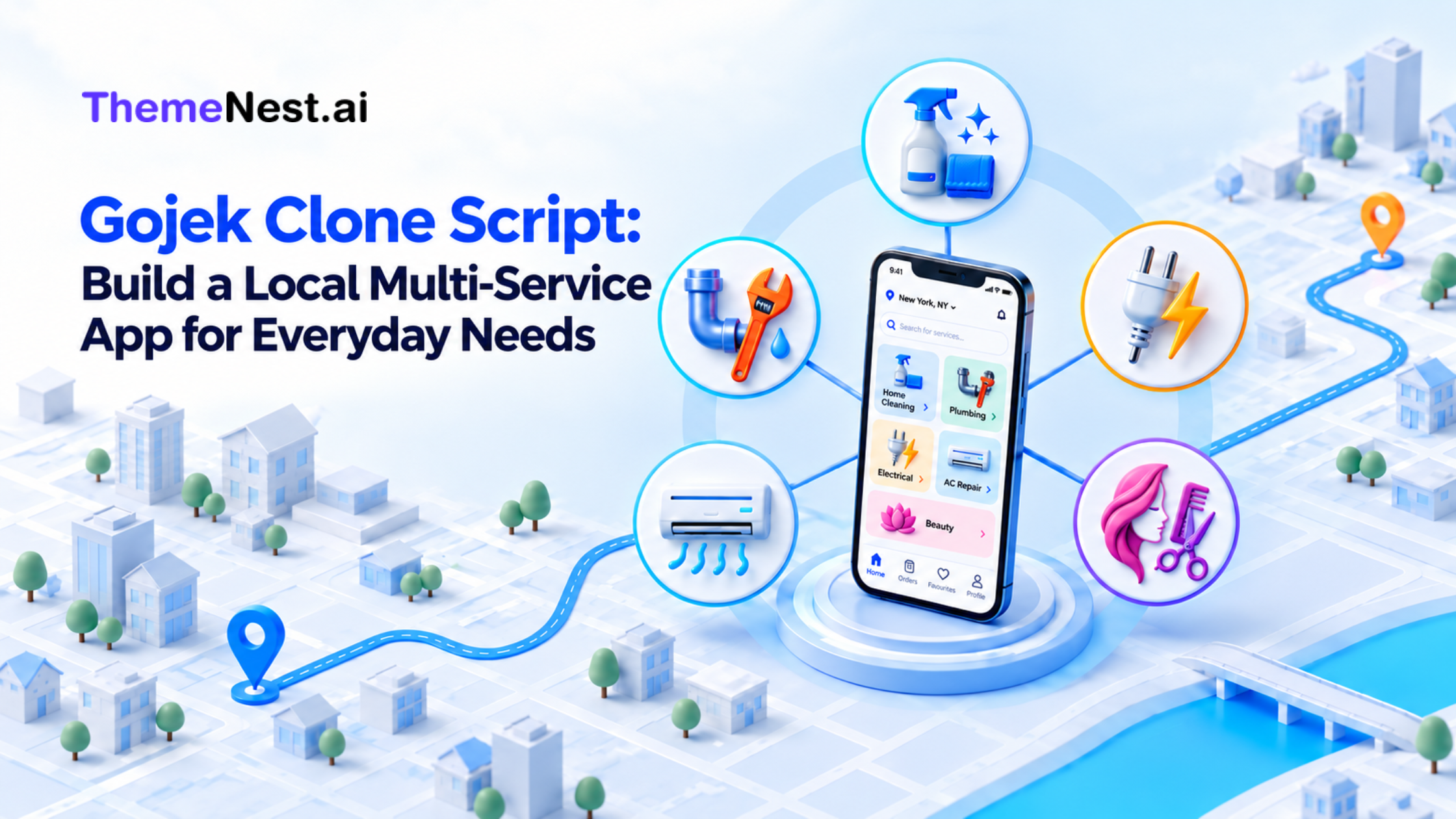
A local multi-service app is an on-demand platform through which customers can find and book nearby service providers. One account gives users access to different services, while a centralized system manages providers, availability, pricing, payments, commissions, service areas, and customer support.
A customer might book bathroom cleaning in the morning, schedule AC servicing for the weekend, and request laundry pickup later using the same app. The customer does not need to create separate accounts or repeatedly share the same address and payment information.
For service professionals, the platform creates a structured way to receive work, manage availability, communicate with customers, complete jobs, and track earnings. For the business owner, it creates multiple revenue streams through one connected ecosystem.
What Is a Gojek Clone Script?
A Gojek clone script is a customizable software solution inspired by the multi-service super-app business model. It commonly includes a customer app, service-provider app, merchant or partner panel, website, and admin dashboard.
The term “clone” refers to familiar business workflows, not copying protected branding, content, design, or source code. A professionally launched platform should have its own identity, interface, service strategy, and market positioning.
Using a ready-made foundation can reduce development time because essential functions—such as registration, location detection, booking, provider assignment, notifications, payments, commissions, ratings, and reports—are already structured. The platform can then be customized for local service categories and regional business requirements.
Local Services You Can Offer Through the App
The strongest multi-service platforms focus on specific, bookable tasks instead of using vague categories. Customers should immediately understand what they can order, what is included, how much it may cost, and when a professional can arrive.
1. Home Cleaning Services
Cleaning is one of the most frequently required local services. The platform can offer full-home cleaning, kitchen deep cleaning, bathroom cleaning, sofa and carpet cleaning, mattress cleaning, water-tank cleaning, balcony cleaning, and move-in or move-out cleaning.
Each service page should explain the estimated duration, team size, equipment used, included areas, exclusions, and price. Customers should be able to choose the property size, add optional tasks, select a time slot, and provide access instructions.
2. Electrician, Plumber, and Handyman Services
Customers regularly need help with switch replacement, light installation, fan repair, water leakage, blocked pipes, tap fitting, furniture assembly, curtain installation, drilling, painting touch-ups, and minor household repairs.
The app can use fixed prices for standard tasks and inspection-based quotations for complex work. The customer should approve any additional material or labour cost digitally before the provider continues.
3. AC and Appliance Repair
Useful categories include AC installation, regular AC servicing, gas refilling, cooling repair, and uninstallation. The same module can cover refrigerators, washing machines, microwaves, geysers, televisions, water purifiers, and kitchen appliances.
Customers can select the appliance brand and problem, upload a photo, choose a convenient slot, and receive an initial inspection price. Service history, spare-part details, digital invoices, and repair warranties make the experience more transparent.
4. Pest Control and Sanitization
The platform can provide pest-control services for cockroaches, termites, bed bugs, mosquitoes, rodents, ants, and other common problems. Home sanitization and commercial-space treatments can also be offered.
Pricing may depend on property type, number of rooms, affected area, and treatment method. Safety instructions, product details, preparation requirements, follow-up visits, and warranty conditions should be clearly displayed.
5. Beauty, Salon, and Wellness at Home
Beauty-at-home services can include haircuts, grooming, facials, waxing, manicure, pedicure, makeup, massage, spa treatments, and event packages. Customers should be able to view provider experience, ratings, service duration, hygiene standards, and available time slots.
The platform can support individual services as well as bundled packages. Professionals may set availability, accept bookings, manage travel time, and track earnings through the provider app.
6. Laundry and Dry-Cleaning Pickup
Customers can schedule doorstep pickup for washing, ironing, dry cleaning, shoe cleaning, curtain cleaning, and blanket cleaning. The workflow may include pickup confirmation, item counting, price approval, processing updates, and scheduled delivery.
Partner laundries need a dashboard to manage orders, item status, delivery dates, pricing, and customer issues. Barcode or order-label tracking can reduce lost-item disputes.
7. Vehicle Care and Roadside Assistance
A local services app can include doorstep car wash, bike wash, interior cleaning, puncture repair, battery jump-start, towing, and basic vehicle servicing. Fuel delivery should be offered only where legally permitted.
Location sharing is essential for roadside requests because the customer may not know the exact address. The app should display the provider’s estimated arrival time and allow secure communication.
8. Moving, Gardening, and Personal Assistance
Additional local services may include packers and movers, furniture shifting, loading help, gardening, cook on demand, driver on demand, babysitting, elderly assistance, pet grooming, pet walking, and event-help staff.
These services often require special verification, experience, equipment, or custom pricing. They should be activated only when the business can consistently maintain provider quality and customer safety.
How the Local Service Booking Process Works
A clear booking journey reduces confusion and cancellations:
- The customer selects a service and enters the address.
- The app displays nearby availability, price, duration, and service details.
- The customer selects a date and time and adds notes or photos.
- The platform assigns a suitable verified professional.
- The provider accepts the request and travels to the location.
- An OTP or customer confirmation starts the job.
- Additional costs require approval through a digital quotation.
- The customer pays after completion and receives an invoice.
- Both sides can provide ratings, feedback, or raise a support request.
The matching system should consider the provider’s skills, distance, availability, rating, service area, equipment, and current workload—not only who is closest.
Essential Features for Customers and Providers
The customer app should include fast registration, location-based service discovery, category search, fixed-price and quotation-based bookings, time-slot selection, live status updates, secure payments, coupons, invoices, booking history, ratings, and in-app support.
Service providers need identity and document verification, skill categories, service zones, online/offline controls, job alerts, navigation, customer instructions, quotation tools, job evidence, earnings reports, commission details, payout tracking, and support.
Trust-building features are especially important for home services. The platform should use verified profiles, masked calling, job-start OTPs, before-and-after photos, clear cancellation rules, service checklists, digital bills, and warranty information.
Centralized Admin Dashboard for Local Operations
The admin dashboard acts as the control center of the platform. Administrators should be able to create service categories and subcategories, define prices, approve providers, manage documents, configure zones, set commissions, handle bookings, issue refunds, resolve disputes, and track payouts.
Advanced reporting should show bookings by category and area, provider acceptance rate, average arrival time, job completion rate, cancellations, repeat bookings, average order value, customer ratings, platform revenue, and provider utilization.
This information helps the business identify which services perform well in each neighbourhood. If AC repair demand rises during summer or deep-cleaning bookings increase before festivals, the platform can onboard more specialists and run targeted promotions.
Technology, Security, and Scalability
Flutter or React Native can be used for cross-platform customer and provider apps, while React or Next.js can support the website and admin panel. Node.js or Laravel can power backend workflows, and PostgreSQL or MySQL can manage structured booking and payment data.
A modular architecture allows new local-service categories to be introduced without rebuilding the entire platform. Map integration supports location detection and provider navigation. Payment gateways handle online transactions, while notification services deliver booking and status alerts.
Security should include encrypted connections, secure authentication, role-based permissions, validated inputs, rate limiting, protected documents, audit logs, backups, and monitored payment workflows. The business must also follow applicable privacy, tax, labour, consumer-protection, and service-specific regulations.
Revenue Models for a Local Services Marketplace
The platform can earn through several methods:
- Commission on every successfully completed booking
- Customer convenience or platform fees
- Provider registration or subscription plans
- Featured placement for selected professionals or partners
- Inspection charges for repair services
- Cancellation fees under transparent conditions
- Service packages and annual maintenance plans
- Corporate cleaning, maintenance, or employee-assistance contracts
Pricing must remain clear. Customers should see what is included, while providers should understand commission deductions and payout schedules. A sustainable model protects service quality instead of depending only on the lowest possible price.
How to Launch the Platform Successfully
Start with market research in one city or a limited group of service areas. Identify the problems customers face when hiring local professionals, including unreliable arrival times, unclear prices, poor-quality work, or a lack of verified providers.
Choose a focused set of high-demand categories such as home cleaning, electrician, plumbing, AC service, appliance repair, and beauty at home. Define service checklists, prices, provider requirements, cancellation rules, and quality standards before launch.
Customize the Gojek clone solution with original branding, regional languages, local currency, payment options, service zones, and customer-support channels. Test the complete journey from registration and booking to payment, refund, warranty, and provider payout.
After launch, measure repeat-booking rate, completion time, customer complaints, provider response, average order value, and profit per service. Expand into laundry, pest control, vehicle care, moving, or personal assistance only after the core categories operate reliably.
How ThemeNest Can Support a Local Multi-Service Business
ThemeNest’s QuickServices solution can support a marketplace for home cleaning, repairs, beauty, maintenance, and other on-demand local services. Businesses that later want to build a broader ecosystem can also evaluate RideON for transportation, FoodXpress for food delivery, FreshMart for grocery delivery, and OpenMart for multi-vendor commerce.
The right solution should match the initial service strategy, required integrations, regional needs, and long-term growth plan. Launching fewer services with dependable quality is more effective than offering many poorly managed categories.
Conclusion
A Gojek clone script can help entrepreneurs build a scalable local multi-service app without creating every technical workflow from scratch. Its real value comes from turning everyday needs—such as home cleaning, plumbing, appliance repair, beauty services, laundry, pest control, and vehicle assistance—into simple and trustworthy booking experiences.
Success depends on more than the number of services available. The platform needs verified professionals, clear pricing, dependable arrival times, secure payments, strong customer support, and consistent quality standards. Start with the services that solve genuine local problems, perfect the booking and fulfilment process, and expand using real customer demand.
Frequently Asked Questions
1. What is a Gojek clone script?
It is a ready-made solution for launching and managing multiple on-demand services through one platform.
2. Which services can be included?
You can offer home cleaning, plumbing, electrical work, AC repair, beauty, laundry, pest control, and more.
3. Can I start with only a few services?
Yes. You can launch with high-demand services and add more categories later.
4. Does the app support provider management?
Yes. Providers can manage bookings, schedules, availability, earnings, and service requests.
5. Can customers track service providers?
Yes. Real-time tracking can show the provider’s location and estimated arrival time.
6. How can the platform generate revenue?
It can earn through commissions, service fees, subscriptions, featured listings, and inspection charges.
7. Can the app support multiple cities?
Yes. Zone-based management allows services, providers, and pricing to be managed across different cities.