






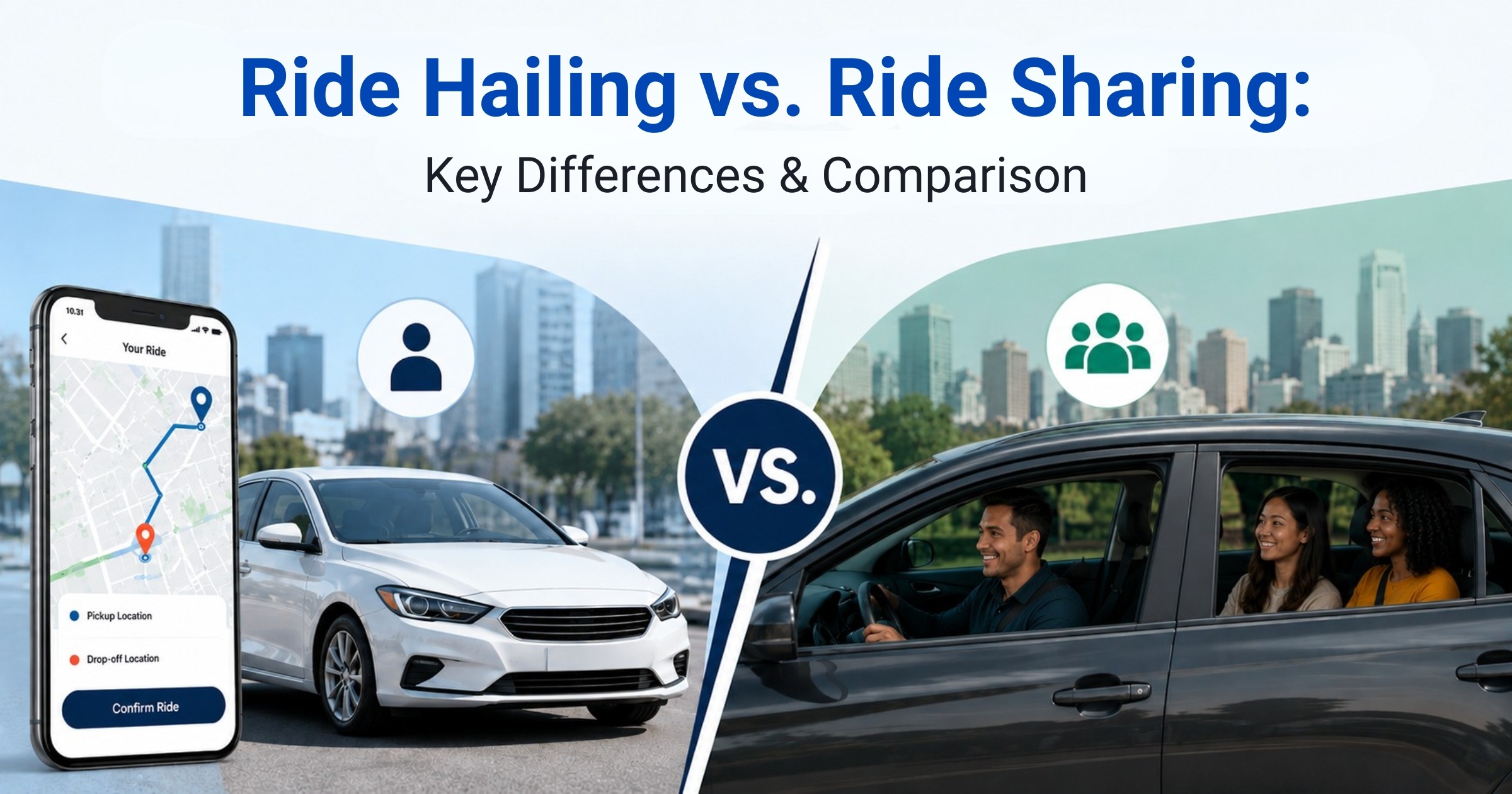
Sarah opens her phone after a long day at work. She needs a ride home — fast, private, no stops. Across town, Raj opens the same kind of app, but he’s fine waiting a few extra minutes if it means splitting the fare with two strangers heading the same way.
Both of them tap “book a ride.” Both get a car. But they’re not using the same kind of service at all.
This mix-up — treating ride hailing and ride sharing as interchangeable — is one of the most common misunderstandings in urban mobility today. The two models look similar on the surface (an app, a driver, a destination) but differ completely in how they’re built, priced, and experienced. If you’re a rider trying to pick the right option, or an entrepreneur trying to decide which business model to build, understanding this difference isn’t optional — it’s foundational.
In this guide, we’ll break down exactly what separates ride hailing from ride sharing, how each one works, what it costs, and which model might make more sense for you.
Ride Hailing vs. Ride Sharing: The One-Line Difference
Before we go deep, here’s the difference in its simplest form:
- Ride Hailing — You hire a private driver and vehicle just for yourself. No stops, no strangers, no shared route.
- Ride Sharing — You share a vehicle with other passengers heading in a similar direction, splitting the cost and the route.
Keep these two definitions in mind — almost everything else in this article builds on them.
What Is Ride Hailing?
Ride hailing is an on-demand transportation service where a rider uses an app to request a private vehicle and driver. It’s essentially a digitized version of hailing a taxi — except instead of waving your hand on a street corner, you tap a button on your phone.
The ride is exclusively yours. There are no other passengers, no shared stops, and the route runs directly from your pickup point to your destination.
Uber, Lyft, Ola, and Careem are the most recognizable names in this category. When most people say “I’ll just Uber there,” they’re talking about ride hailing — even if they call it “ride sharing” out of habit.
How Does Ride Hailing Work?
- The rider opens the app and enters a pickup location and destination.
- The platform’s matching system finds the nearest available driver and assigns the trip.
- The driver heads directly to the pickup point, and the trip runs start to finish without added stops.
- Payment, fare estimate, and driver details are all handled inside the app — no cash, no haggling.
The entire system is optimized around one goal: speed. One rider, one driver, one direct route, as fast as possible.
What Is Ride Sharing?
Ride sharing — sometimes called rideshare or on-demand carpooling — is a service where multiple passengers travel in the same vehicle, on routes that overlap, splitting both the ride and the cost.
It’s built on a completely different assumption than ride hailing: that trips don’t need separate cars when people are already heading the same way. Instead of matching one rider to one driver, the system looks for patterns — who else is going in a similar direction at a similar time — and groups them together.
BlaBlaCar and Via are commonly cited examples of dedicated ride-sharing platforms, and several major ride-hailing apps also offer a shared option (like UberX Share) layered on top of their core hailing service.
How Does Ride Sharing Work?
- A rider requests a trip, and the system scans nearby requests for others heading in a similar direction.
- Routes are reshaped slightly to combine multiple trips without turning them into long detours.
- Pickups and drop-offs are sequenced to keep the ride reasonably predictable for everyone involved.
- The fare is split between passengers, making each individual trip cheaper than a private ride.
The trade-off is built into the model: you may wait a little longer or take a slightly longer route, but more people move through the city using fewer vehicles — which is exactly where ride sharing earns its value.
Platforms for Each Service
| Type | Popular Platforms | What They Focus On |
| Ride Hailing | Uber, Lyft, Ola, Careem, Didi | Private, on-demand, point-to-point trips |
| Ride Sharing | BlaBlaCar, Via, UberX Share, Lyft Line | Shared trips, split fares, route-matching |
Notice that some companies — like Uber and Lyft — actually operate in both categories. Their core product is ride hailing, but they layer a ride-sharing option on top for cost-conscious users willing to share a route. This is part of why the two terms get blurred so often in everyday conversation.
Key Differences Between Ride Hailing and Ride Sharing
Here’s where the two models really pull apart. Use this table as your quick-reference comparison:
| Aspect | Ride Hailing | Ride Sharing |
| Booking Process | Private ride booked directly through the app | App matches you with others heading the same way |
| Vehicle Occupancy | Just you (and anyone you bring) | Shared with other unrelated passengers |
| Route | Direct, no detours | Multiple pickups/drop-offs along the way |
| Trip Duration | Shorter | Longer, due to extra stops |
| Cost Per Rider | Full fare, paid by one person | Split among passengers — cheaper per person |
| Profit Margin (operators) | Higher per trip | Lower per trip, but higher volume |
| Privacy | High — private cabin | Low — shared with strangers |
| Environmental Impact | More vehicles on road, higher emissions | Fewer vehicles per passenger, lower emissions |
| Best For | Speed, privacy, time-sensitive trips | Budget-conscious, eco-friendly, flexible travel |
| City Scalability | Can strain capacity at peak demand | Improves with higher rider density |
Pricing Models Compared: Surge vs. Split-Fare
Pricing is one of the most practical differences riders actually feel — and it works completely differently in each model.
Ride Hailing — Surge Pricing
Ride-hailing platforms typically use dynamic or surge pricing, where fares fluctuate based on real-time demand, time of day, weather, or local events. The base fare is calculated using distance and time, but during high-demand periods (rush hour, late nights, big events), prices can rise sharply — sometimes 2-3x the normal rate. The full cost is borne by a single rider, which is part of why these trips cost more overall, but the fare is transparent and shown upfront before you confirm the booking.
Ride Sharing — Split-Fare Pricing
Ride-sharing platforms calculate a base trip cost and then divide it among all passengers traveling on overlapping routes. Since the cost is distributed, each individual rider pays significantly less than they would for a private trip covering the same distance — often 40-50% less. Pricing here is generally more stable and predictable since it’s less tied to real-time demand spikes and more to route-matching efficiency. The trade-off for that lower price is reduced certainty over exact pickup timing and route, since it depends on who else gets matched into the trip.
In short: ride hailing prices for convenience and exclusivity; ride sharing prices for efficiency and shared cost.
Advantages and Disadvantages of Ride Hailing
Advantages
- Convenience — book a private ride anytime, anywhere, in seconds
- Privacy — no strangers, no shared cabin
- Speed — direct route with no extra stops
- Flexibility — choice of vehicle types, from economy to premium
- Cashless payments — fully digital, in-app transactions
Disadvantages
- Higher cost — you pay the full fare alone
- Surge pricing — costs spike during high-demand periods
- More traffic & emissions — one vehicle per rider adds up
- Limited rural availability — strongest in dense urban areas
Advantages and Disadvantages of Ride Sharing
Advantages
- Cost-effective — fare split among passengers
- Eco-friendly — fewer vehicles per passenger, lower emissions
- Reduces congestion — more people moved per car
- Predictable pricing — less exposure to surge spikes
Disadvantages
- Longer trip times — multiple pickups and drop-offs
- Less privacy — shared cabin with strangers
- Less route certainty — detours depend on who’s matched in
- Limited availability — less common outside major cities
Market Size & Growth (2023–2025)
Both models have grown steadily, but at noticeably different paces — which tells its own story about where each is headed.
| Year | Ride Hailing Market Size | Ride Sharing Market Size |
| 2023 | ~$150 billion | ~$85 billion |
| 2024 | ~$175 billion | ~$95 billion |
| 2025 | ~$180 billion | ~$105 billion |
Ride hailing’s growth has slowed in recent years as the market matures and competition intensifies, while ride sharing has continued a steadier, more consistent climb — driven by rising cost-consciousness and sustainability concerns among urban commuters. Note: these figures are industry estimates and should be treated as directional rather than exact.
The Future of Ride Hailing and Ride Sharing
Both models are heading toward the same broad set of technologies, just with different priorities:
- Autonomous vehicles — Ride-hailing companies like Uber and Lyft are already piloting self-driving fleets, which could eliminate driver costs and reduce per-ride pricing over time.
- Electric vehicles — Both models are integrating EVs to cut fuel costs and reduce emissions, with ride-hailing fleets adopting them fastest due to higher trip volume.
- AI-driven matching — Ride-sharing platforms are getting smarter at predicting routes and grouping riders efficiently, shrinking wait times and detours.
- Regulatory pressure — Cities are increasingly favoring shared-trip models to reduce congestion, which could push more ride-hailing companies to expand their shared-ride offerings.
The direction is clear: ride hailing is optimizing for speed and automation, while ride sharing is optimizing for density and efficiency.
Which Model Should You Choose for Your Business?
If you’re building a mobility platform rather than just using one, the choice comes down to your goals.
Choose Ride Hailing if:
- You want higher profit margins per trip
- Your target market values speed and privacy over cost
- You’re launching in a dense urban area with strong on-demand demand
- You want a simpler operational model (no route-matching complexity)
Choose Ride Sharing if:
- You want to position around affordability and sustainability
- Your target users are cost-conscious, regular commuters
- You’re comfortable with more complex routing and matching logic
- You’re aiming for a long-term, community-driven model with lower per-trip margins but higher volume
Many successful operators don’t pick just one — they start with ride hailing for faster market entry and layer in shared-ride options once they’ve built rider density.
If ride hailing is the direction you’re leaning, you don’t have to build the technology from scratch. Platforms like RideOn by ThemeNest offer a ready-made, white-label solution — complete with a rider app, driver app, and admin panel — that lets you launch your own branded taxi booking business without months of custom development. It’s the kind of infrastructure that makes the “build vs. buy” decision straightforward for first-time mobility entrepreneurs.
Conclusion
Ride hailing and ride sharing solve the same basic problem — getting from point A to point B — but they take fundamentally different paths to do it. Ride hailing is built around privacy, speed, and direct routes, at a higher individual cost. Ride sharing is built around shared capacity, lower cost, and better efficiency, at the expense of some time and privacy.
Neither model is universally “better.” The right choice depends on what you — or your business — actually value: convenience or affordability, privacy or sustainability, speed or efficiency. Understanding the real difference between the two means you’re no longer just picking based on habit or branding — you’re picking based on what actually fits your trip, or your business.
FAQs
1.What is the main difference between ride hailing and ride sharing?
Ride hailing gives you a private vehicle just for yourself, qbooked directly through an app. Ride sharing matches you with other passengers heading the same way, splitting both the ride and the cost.
2.Is UberPool ride hailing or ride sharing?
It’s a hybrid. UberPool (and similar options like UberX Share or Lyft Line) is a shared-ride feature layered on top of a primarily ride-hailing platform — so it functions as ride sharing, even though it runs through a ride-hailing app.
3.Which is cheaper — ride hailing or ride sharing?
Ride sharing is generally cheaper per person since the fare is split among multiple passengers. Ride hailing costs more because one rider covers the full fare alone.
4.Which is more environmentally friendly?
Ride sharing has a lower environmental footprint per passenger since it moves more people using fewer vehicles. Ride hailing, with one car per rider, contributes more to traffic and emissions.
5.Can I start a business in either model?
Yes. Both are viable business models with different trade-offs — ride hailing offers higher margins per trip but more competition, while ride sharing offers lower margins but stronger long-term sustainability positioning.